7 Budget Friendly Backyard Adventures for Curious Toddlers

The Tiny Gardener Kit
Backyard Scavenger Hunt
Mud Kitchen Magic
Bubble Extravaganza
Nature's Texture Walk
Shadow Drawing Station
Water Play Discovery
Are you wondering how to keep a high-energy toddler entertained without spending a fortune on plastic toys or expensive outings? This post explores seven ways to turn your backyard into a developmental playground using common household items and natural elements. These activities focus on sensory play, motor skills, and cognitive curiosity—all of which are vital for a growing child's development.
How Can Outdoor Play Help Toddler Development?
Outdoor play helps toddlers develop gross motor skills, sensory processing, and social-emotional regulation through movement and exploration. When a child moves through uneven grass or climbs a low tree limb, they aren't just burning energy. They are building spatial awareness and balance. Even a simple backyard becomes a classroom for physical milestones.
The Centers for Disease Control and Prevention highlights how active play supports healthy physical growth. You don't need a fancy playground to hit these milestones. You just need a little bit of space and some intentionality.
Actually, sometimes the simplest setups are the most effective. A toddler might spend twenty minutes staring at an ant crawling through the dirt—and that's perfectly fine. That's observation in action.
1. The Sensory Mud Kitchen
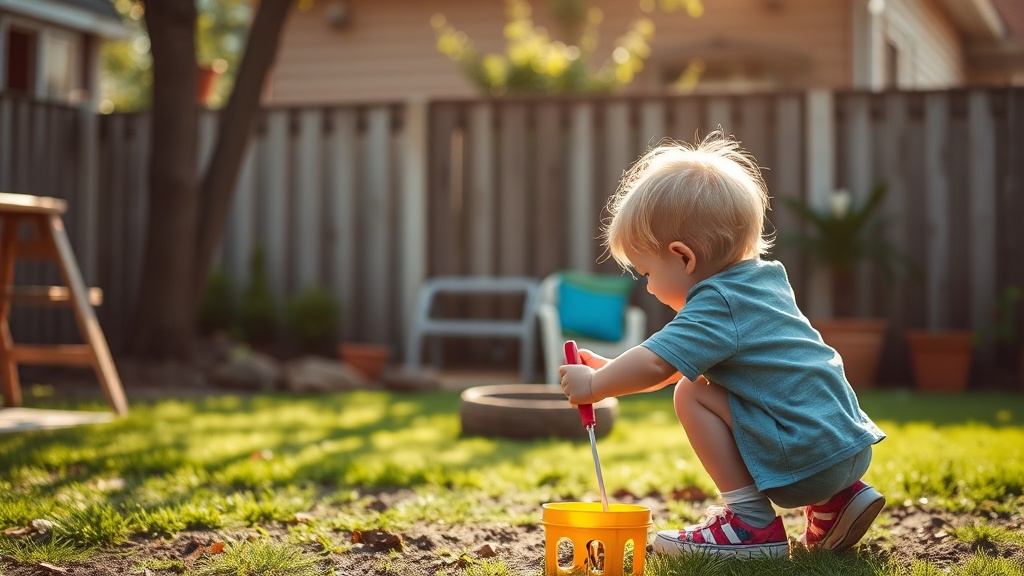
A mud kitchen is a low-cost way to encourage sensory exploration and imaginative play. You don't need to buy a pre-made wooden set; an old plastic bin, some old spoons, and a few bowls from your kitchen will do the trick. Add a little water and some dirt, and suddenly, your child is a chef preparing "dirt soup."
This type of play is great for fine motor skills. They’re learning how much pressure to use when stirring or pouring. It’s messy, yes, but it’s also a way for them to understand textures and consistencies. If you're worried about the mess, keep a bucket of water and a towel nearby for quick cleanups.
2. Nature Scavenger Hunts
A scavenger hunt turns a basic walk around the yard into a cognitive challenge. Instead of a complex list, give your toddler a visual one. You can use a piece of cardboard with shapes or colors drawn on it. If they find a yellow flower, they match it to the yellow circle. It’s a great way to boost language development by naming the objects they find.
Try searching for:
- Something bumpy (bark or a stone)
- Something soft (a leaf or petal)
- Something green (grass or a leaf)
- Something round (a pebble or a berry)
3. Water Play Stations
Water is one of the most engaging tools for a toddler. A simple plastic tub filled with a few inches of water and some measuring cups can provide an hour of entertainment. You can add drops of food coloring or even a bit of dish soap to create bubbles. It’s basically a science experiment in a bucket.
This activity teaches cause and effect. "If I tip this cup, the water spills." It also builds hand-eye coordination. If you have a small wading pool, you can even add floating toys like a rubber duck or a plastic boat.
How Much Does Backyard Play Cost?
Most backyard adventures cost less than $10 or even $0 if you use items you already own. Most of these activities rely on "loose parts"—items that don't have one specific way to be played with. This is the core of many Montessori-inspired approaches to learning.
| Activity | Estimated Cost | Primary Skill Developed |
|---|---|---|
| Mud Kitchen | $0 (Use old kitchenware) | Sensory & Fine Motor |
| Nature Scavenger Hunt | $0 | Observation & Language |
| Water Play | $0 - $5 | Cause & Effect |
| Sidewalk Chalk Art | $3 - $5 | Creativity & Grip |
4. Sidewalk Chalk Masterpieces
Sidewalk chalk is a classic for a reason. It’s inexpensive and offers endless possibilities. You can have them draw large circles and try to "jump" into them, which helps with gross motor control. Or, they can practice drawing lines and shapes. It’s a tactile way to practice pre-writing skills without the pressure of a pencil and paper.
If you want to get fancy, use a spray bottle with water. They can draw a shape with the chalk, then use the spray bottle to "erase" it. This adds a layer of hand-strength training that's quite helpful for later developmental stages.
5. The "Obstacle Course" Challenge
You can build an obstacle course using things you already have lying around. A laundry basket for them to crawl through, a low garden hose to step over, or a sturdy stool to step onto. This is much more effective for building confidence than a structured gym class. It encourages them to test their physical limits in a safe environment.
As they master each part of the course, they gain a sense of achievement. This is a fundamental part of building self-reliance and confidence. They realize, "I can do this!" even when it feels a little tricky at first.
6. Texture Walks
A texture walk is a way to engage the sense of touch and balance simultaneously. Lay out different surfaces in a safe path. This could be a patch of smooth stones, a section of grass, a piece of cardboard, or even a towel laid on the ground. Let them walk (carefully!) over the different textures with bare feet.
Barefoot play is excellent for proprioception—the sense of where your body is in space. It also helps them get used to different tactile inputs, which can be a huge help for children who might be sensitive to textures in other ways.
7. Shadow Tracking
This is a free, high-engagement activity that requires almost zero setup. On a sunny day, watch how shadows move. You can use sidewalk chalk to trace your child's shadow on the ground, or trace the shadow of a plant or a toy. It’s a fascinating way for them to understand light and movement.
The movement of the sun is a slow, constant change. Watching the shadow move or change shape can be incredibly soothing and keeps a toddler engaged in a quiet, observational way. It's a nice way to wind down an afternoon of high-energy play.
The goal isn't to create a perfect, Pinterest-worthy scene. It’s about the messy, unscripted moments where your child learns something new about the world. Whether they are splashing in a puddle or digging in the dirt, they are building the foundations of how they interact with their environment. Grab some old spoons, head outside, and let the exploration begin.